
Refrigerator Running Constantly? What a Fridge Repair Technician Checks Before Blaming the Compressor
Refrigerator won't stop running? Learn what a fridge repair technician checks, including airflow, door seals, sensors, frost patterns, and sealed-system performance.
A refrigerator that seems to run all day can make homeowners think the compressor is about to fail. Sometimes a long run time is normal, especially after a large grocery load, frequent door openings, hot weather, or a recent power interruption. But when the refrigerator rarely shuts off and temperatures are starting to drift, the right approach is to test the complete cooling system before blaming the compressor.
This matters because a refrigerator can run constantly for several very different reasons. Poor airflow, a door that is not sealing, an inaccurate temperature sensor, a defrost problem, dirty condenser coils, or a sealed-system issue can all keep the control asking for more cooling. When someone searches for fridge service repair near me, the goal should be a proper diagnosis instead of replacing expensive parts based on the symptom alone.
Start With the Actual Refrigerator and Freezer Temperatures
The sound of a fan does not always mean the compressor is running. Modern refrigerators may operate evaporator or condenser fans at different times, and variable-speed compressors can be much quieter than older designs. Before diagnosing a refrigerator that “runs constantly,” we want to know what the temperatures are actually doing.
A homeowner can place an appliance thermometer in the fresh-food section and freezer and monitor temperatures over several hours while keeping the doors closed as much as possible. If the refrigerator runs for long periods but maintains normal temperatures, the issue may be different from a machine that runs continuously while the fresh-food section climbs into the 40s.
Dirty Condenser Coils Can Make the Refrigerator Work Harder
Many refrigerators have condenser coils underneath or behind the cabinet. Their job is to release heat that has been removed from inside the refrigerator. If the coils are packed with dust, pet hair, or debris, or if airflow around the condenser is restricted, the refrigerator may need to operate longer to remove the same amount of heat.
Not every refrigerator has exposed coils that homeowners should clean, so check the owner's manual first. If the coils are accessible, disconnect power before cleaning around them. Never reach around a running fan or remove electrical covers.
We also inspect the condenser fan on models that use one. A failed fan can cause unusually high temperatures around the compressor and condenser area and reduce cooling efficiency even though the compressor keeps running.
Door Seal Problems Keep Adding Heat and Humidity
A refrigerator cannot satisfy its temperature setting if warm kitchen air is constantly leaking through a door that is not closing properly. We check for food packages holding the door open, misaligned doors, damaged gaskets, debris on the sealing surface, and hinges that allow the door to sag.
Heavy condensation around the door opening or repeated frost near one section of the gasket can be a clue. A simple homeowner check is to inspect the gasket visually and make sure nothing is preventing the door from closing completely. Replacing the gasket should not be the first move unless it is actually torn, distorted, or no longer sealing correctly.
Temperature Sensors Can Keep the Compressor Running
Most newer refrigerators use thermistors instead of a simple mechanical cold control. A thermistor changes resistance as temperature changes, and the electronic control uses that information to decide when to run the compressor and fans.
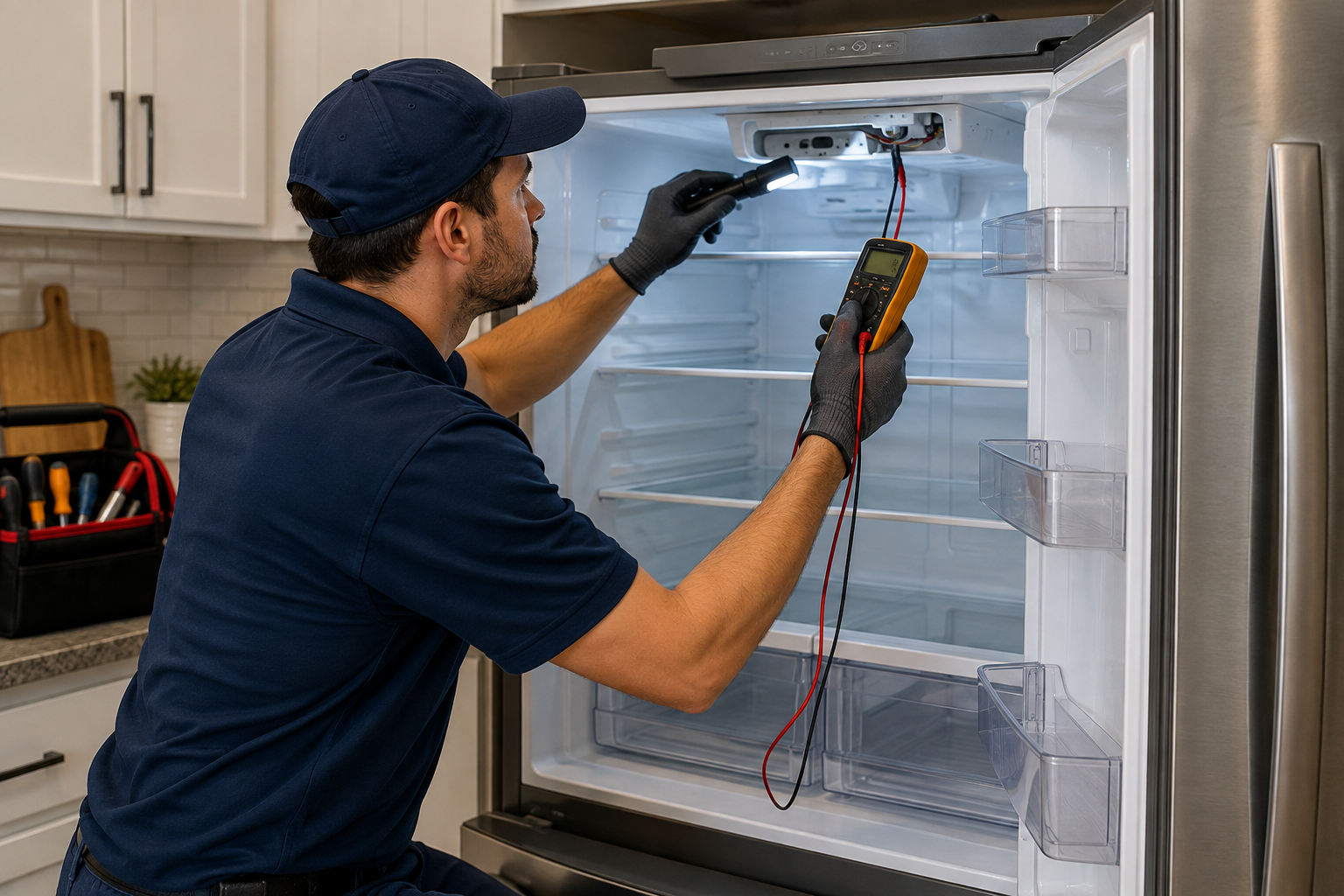
If a sensor is out of calibration, the control may receive temperature information that does not match the real compartment temperature. The refrigerator may then run longer than necessary or may not cool correctly. During professional refrigerator repair, technicians may compare sensor readings with manufacturer specifications or use the appliance's diagnostic mode when available.
This is why replacing a control board without testing the sensors first can turn into an expensive guess. The board may be doing exactly what it was told to do based on bad information from another component.
Heavy Frost Can Block Airflow
On many frost-free refrigerators, the evaporator is hidden behind a panel in the freezer. If the automatic defrost system stops working correctly, frost can build across the evaporator until airflow becomes restricted. The compressor may keep running because the refrigerator never reaches the control's target temperature even though the evaporator itself is very cold.
Homeowners may notice a freezer back wall covered with frost, reduced air coming from refrigerator vents, or a fresh-food section that warms while part of the freezer still feels cold. A technician may test the defrost heater, temperature-sensing components, wiring, fan operation, and electronic controls depending on the model.
The Evaporator Frost Pattern Tells Us a Lot
One of the most useful diagnostic clues is the frost pattern on the evaporator after the refrigerator has been operating. A healthy refrigeration system generally develops cooling across the evaporator rather than producing one small ice ball or frost patch at the refrigerant inlet.
A refrigerator that runs constantly but cannot reach temperature may have a sealed-system problem such as a refrigerant leak, restriction, weak compressor, or another refrigeration-system fault. In that situation, replacing a thermistor or control board will not solve the actual cooling problem.
When Constant Running Is Normal
Some refrigerators are designed for long compressor run times, especially newer high-efficiency and variable-speed models. The refrigerator may also run longer after adding warm groceries, after the doors have been opened repeatedly, during very hot weather, or after the unit has been unplugged and restarted.
The warning sign is not simply that the refrigerator runs a lot. We become more concerned when long run times are combined with warm temperatures, excessive frost, unusual clicking, a very hot compressor area, weak airflow, or food freezing where it should not.
What a Fridge Repair Technician Checks Before Recommending Parts
A proper diagnosis starts with temperatures and airflow. From there, we check door sealing, condenser condition, fan operation, evaporator frost pattern, sensor readings, defrost operation, and the electrical commands being sent to the cooling components. On some models, service diagnostics and stored fault codes provide additional clues.
That process prevents expensive guesswork. A refrigerator that runs constantly can have a relatively simple airflow problem or a much more serious sealed-system failure, and the symptom alone does not tell us which one it is.
If your refrigerator is running nearly nonstop and temperatures are no longer stable, you can also review our same day fridge repair information or find broader appliance repair near me service options. When you're ready to have the refrigerator diagnosed, you can schedule appliance service with General Appliance Service.