
Key Takeaways for a Slow-Drying Dryer
A clothes dryer needs heat, tumbling and steady airflow to remove moisture. When humid air cannot escape, clothes remain damp while heat builds inside the appliance and ductwork.
According to the U.S. Fire Administration, failure to clean was the leading factor contributing to the ignition of 31% of home clothes-dryer fires reported from 2018 through 2020.
| What You Notice | What It May Indicate | What to Do Next |
|---|---|---|
| Clothes suddenly require two cycles | Restricted airflow, overloading or a dryer malfunction | Clean the lint screen and perform the outdoor airflow check |
| Weak airflow at the exterior vent | Lint buildup, crushed ductwork, a stuck vent cover or blower trouble | Turn the dryer off and arrange an inspection |
| No airflow at the exterior vent | A serious blockage, disconnected duct or failed blower | Stop using the dryer until the cause is identified |
| Strong airflow but damp clothes | Heating, moisture-sensor, thermostat or washer spin-cycle problem | Schedule an appliance diagnosis |
| Burning smell, smoke or unusual heat | Overheating, lint ignition or an electrical problem | Stop the dryer immediately and follow the emergency guidance below |
Why Restricted Airflow Makes a Dryer Take Longer
Your dryer heats the clothes and moves warm air through the drum. That air absorbs moisture before traveling through the lint screen, internal housing, connecting duct and exterior vent.
When the exhaust path is restricted, moisture cannot leave efficiently.
The dryer may continue heating and tumbling, but humid air remains trapped around the clothes. This can produce several noticeable symptoms:
- Longer drying times
- Damp clothes at the end of a normal cycle
- A laundry room that feels unusually warm
- A dryer cabinet that feels hotter than usual
- A musty or overheated smell
- Repeated cycle extensions
- The dryer shutting down before the load is dry
A slow dryer should not automatically be blamed on a failed heating element. In many cases, the first thing to investigate is airflow.
How to Perform the 60-Second Outdoor Dryer Vent Check
This check requires no tools and can help you identify a possible airflow restriction.
- Clean the lint screen completely. Remove all visible lint before beginning the test.
- Place a normal-sized load in the dryer. Do not overfill the drum.
- Start a regular heated cycle. Allow the dryer to run for approximately one minute.
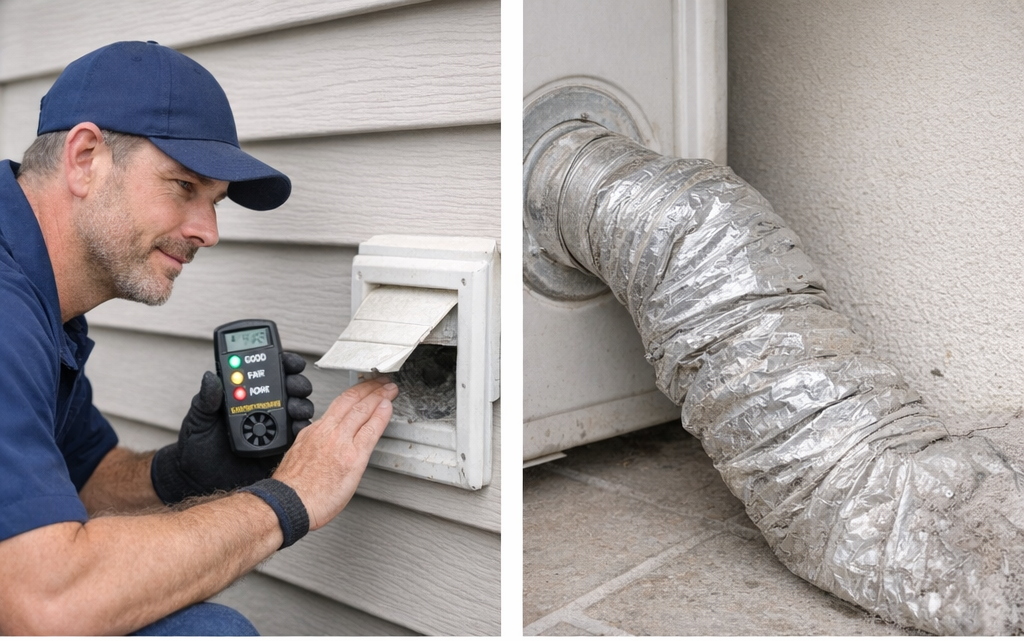
- Locate the exterior dryer vent. This is normally found on an outside wall, although some homes vent through the roof.
- Observe the exterior vent cover. The flap should open while the dryer is operating.
- Place your hand near the opening. You should feel a noticeable, steady stream of warm exhaust air.
Safety note: Do not insert your fingers, tools or other objects into the vent opening. The exterior cover and exhaust air may be hot.
This check is a screening tool rather than a complete diagnosis. A professional airflow measurement may still be needed to determine whether the vent is operating within an acceptable range.
What Your Outdoor Airflow Result Means
| Airflow Result | Possible Explanation |
|---|---|
| Strong, steady and warm airflow | The exhaust path may be clear. Investigate load size, washer performance, heating and sensor problems. |
| Weak airflow | The duct may contain lint, be partially crushed or have too many restrictive turns. |
| Airflow that pulses or stops | The exterior flap may be sticking, or an obstruction may be moving inside the duct. |
| No airflow | The vent may be severely blocked or disconnected, or the dryer blower may not be operating. |
| Strong airflow that is not warm | The dryer may have a heating-system problem. |
| Air escaping behind the dryer | The connecting duct may be loose, torn or disconnected. |
If you cannot feel airflow, turn the dryer off and avoid running another heated cycle until the exhaust system and appliance have been inspected.
Five Common Dryer Vent Blockages
Lint Accumulation Inside the Duct
The lint screen captures a large amount of material, but it does not catch everything. Small fibers can pass through the filter and gradually collect inside the dryer housing and exhaust duct.
Long vent runs and ducts with multiple turns are especially vulnerable to buildup.
A Crushed Transition Hose
The short section connecting the dryer to the wall can become crushed when the appliance is pushed back too far.
Even a clean duct cannot move air efficiently when the connecting hose is flattened or sharply kinked.
A Stuck Exterior Vent Flap
Paint, corrosion, lint and physical damage can prevent an exterior vent flap from opening properly. The cover may look normal when the dryer is off but remain closed when the appliance starts.
Outdoor Debris or Animal Activity
Leaves, nesting material and other debris can obstruct the exterior termination. Exterior vent covers should be inspected without reaching into the duct or disturbing wildlife.
An Internal Blower Problem
Not every airflow problem is caused by the duct. A loose, damaged or obstructed blower wheel can reduce the amount of air moving through the dryer.
This requires appliance diagnosis rather than vent cleaning alone.
Why Cleaning the Lint Screen May Not Solve the Problem
Cleaning the lint screen before or after every load is essential, but the screen is only one section of the dryer’s exhaust system.
Lint can also collect:
- Beneath the lint-screen housing
- Around the blower assembly
- Inside the flexible connecting duct
- Within concealed wall or ceiling ductwork
- Around the exterior vent opening
- Behind the dryer and underneath nearby cabinets
The U.S. Consumer Product Safety Commission recommends periodically cleaning the dryer vent and exhaust duct.
It also recommends replacing plastic or foil accordion-style ducting with rigid or corrugated semi-rigid metal ducting because flexible materials can trap lint and are more vulnerable to crushing.
Always follow the installation and maintenance instructions provided by your dryer’s manufacturer.
Warning Signs You Should Not Ignore
Arrange an inspection when you notice one or more of the following:
- A normal load requires more than one cycle.
- Towels and heavier items remain damp.
- The exterior vent flap barely opens.
- The dryer repeatedly stops before completing a cycle.
- The top or sides of the appliance feel unusually hot.
- You notice a burning, smoky or electrical odor.
- Lint collects around the dryer or exterior vent.
A sudden change is particularly important. When the same appliance, cycle and load size begin producing different results, something in the drying system has changed.
What Homeowners Can Check Safely
| Homeowner Check | Professional Service Is Recommended When |
|---|---|
| Clean the removable lint screen | Lint is visible inside the dryer cabinet |
| Check whether the exterior flap opens | The vent exits through the roof |
| Look for a visibly crushed connecting duct | The dryer is gas-powered and must be disconnected |
| Remove clutter from around the appliance | Electrical components need testing |
| Confirm the dryer is not overloaded | The duct runs through walls, ceilings or multiple floors |
| Check that the washer completed its spin cycle | Airflow remains weak after accessible areas are checked |
Do not disassemble the dryer, disconnect a gas line or reach into concealed ductwork unless you have the proper training and equipment.
When the Dryer, Not the Vent, May Be the Problem
Strong outdoor airflow does not rule out an appliance malfunction.
A dryer may still take too long because of:
- A failed or weakened heating element
- A gas ignition or valve problem
- A malfunctioning thermostat or thermistor
- Dirty or damaged moisture-sensor bars
- A blower wheel that is loose on the motor shaft
- An internal lint restriction
- Incorrect control-board operation
- A washer that is not extracting enough water during the spin cycle
- An oversized or tightly packed load
Brand-specific fault codes and diagnostic procedures may also be needed. Palm Coast homeowners experiencing problems with a General Electric dryer or another GE appliance can learn more about professional GE appliance repair in Palm Coast.
If outdoor airflow appears normal but the dryer still needs multiple cycles, the issue may be inside the appliance. Review our dryer repair services in Palm Coast or our dryer repair services in St. Augustine to confirm service availability for your location, appliance brand, model and symptoms.
Emergency Dryer Safety
Stop using the dryer immediately if you notice smoke, visible flames, sparking or a strong burning smell.
- Turn the appliance off only when it is safe to do so.
- Do not open the dryer door when you suspect an active fire.
- Leave the home and call 911 when smoke or fire is present.
- Do not attempt to extinguish a growing appliance fire yourself.
- Do not operate the dryer again until it has been professionally inspected.
For a gas dryer, leave the area and contact emergency services or the gas utility if you smell gas.
Professional Dryer Diagnosis in Palm Coast and St. Augustine
General Appliance Service diagnoses dryer performance problems and appliance-related airflow issues. A technician can determine whether slow drying is caused by the dryer, the transition duct or another part of the exhaust path.
Professional diagnosis may include:
- Measuring airflow
- Inspecting the accessible transition duct
- Testing dryer temperatures
- Checking the blower wheel
- Examining heating and ignition components
- Testing thermostats, thermistors and moisture sensors
- Looking for internal lint accumulation
- Confirming that the dryer is vented correctly
General Appliance Service provides appliance diagnosis and repair. Full cleaning of concealed household dryer-vent systems may require a qualified dryer-vent cleaning provider. Confirm the exact service scope when scheduling.
For local service information, visit appliance repair in Palm Coast or appliance repair in St. Augustine.
GE appliance owners can also review GE appliance repair in Palm Coast.
Frequently Asked Questions About Slow Dryers
Why does my dryer take two cycles to dry clothes?
Restricted airflow is one possible cause, but overloading, weak heating, defective sensors or a washer that leaves clothes excessively wet can produce the same symptom. Begin with the lint screen and outdoor airflow check.
Does a clean lint screen mean the dryer vent is clear?
No. Lint can accumulate beyond the removable screen, including inside the dryer cabinet, connecting hose and concealed exhaust duct.
Can I continue using my dryer when the airflow is weak?
Continuing to operate a dryer with weak or missing exhaust airflow can increase drying times and heat buildup. Turn the appliance off and have the cause identified before using it again.
How often should a dryer vent be cleaned?
Cleaning frequency depends on the dryer, vent length, number of turns, household size and laundry volume. Inspect the system periodically and follow the maintenance schedule in the manufacturer’s instructions. Have it checked sooner when drying time increases.
Why is my dryer hot but my clothes are still wet?
The dryer may be generating heat without removing humid air efficiently. A restricted exhaust path, overloaded drum or internal airflow problem should be investigated.
Can a blocked dryer vent damage the dryer?
Restricted airflow can make components operate at higher temperatures and may cause repeated safety-thermostat cycling. Over time, the added heat and longer operating periods can contribute to premature component wear.
Final Reminder: A Slow Dryer Is a Warning Sign
When a dryer suddenly takes longer, do not assume that running another cycle is the only solution.
Clean the lint screen, perform the 60-second outdoor airflow check and pay attention to unusual heat, smells and noises. Weak or missing airflow should be investigated before the dryer is used again.
A quick inspection may uncover a simple crushed duct or blocked exterior cover. It may also reveal an appliance problem that requires professional diagnosis.
Either way, finding the cause early can help protect your dryer, reduce wasted drying time and keep your home safer.